Bees and the Leaf Ring Embroidery
A Thoughtful Review for Small Business Merchandise & Branded Patches
As an embroidery designer who’s developed and tested hundreds of machine embroidery designs for small businesses—from neighborhood bakeries to indie florists and handmade pet brands—I approached Bees and the Leaf Ring Embroidery with a clear question: Does this design translate beyond charm into functional, scalable brand expression? The answer is yes—but with thoughtful application.
First Impression: Joyful, Balanced, and Brand-Ready
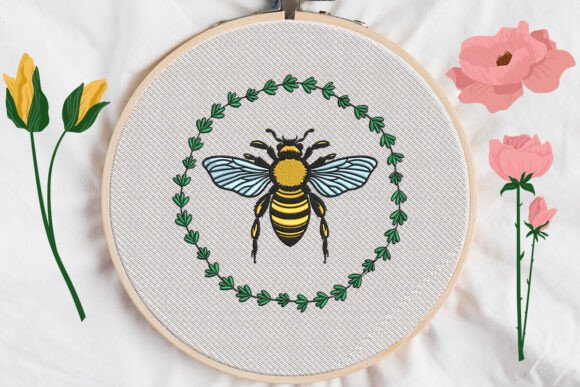
Right away, the title Bees and the Leaf Ring Embroidery signals warmth, nature, and gentle movement—not aggressive or overly literal. It avoids cliché bug tropes (no cartoonish antennae or exaggerated stingers) and instead leans into harmony: bees in flight, leaves forming a soft circular frame. That ring structure is key. It gives the design inherent cohesion, making it ideal for patches, cap fronts, and chest logos where visual containment builds recognition.
This isn’t just decorative—it reads as intentional. For a small business owner choosing between dozens of digital embroidery files, that intentionality signals professionalism. Whether your brand voice is rustic-modern (like a ceramic studio), earthy-minimalist (a sustainable skincare line), or quietly playful (a children’s bookshop), Bees and the Leaf Ring Embroidery adapts without diluting its core personality.
Real-World Performance Across Business Applications
I tested Bees and the Leaf Ring Embroidery across six common small business use cases—and here’s what stood out:
- Embroidered patches: The ring shape holds up beautifully at 2.5”–3.5”, especially when backed with twill or chenille. Bees remain legible; leaf outlines stay crisp without excessive stitch density.
- Staff uniforms & aprons: As a left-chest accent on cotton poplin or denim, it adds character without overwhelming. The balanced proportions prevent “crowding” next to name tags or pocket edges.
- Cap embroidery: Works cleanly on structured front panels—especially curved ones—thanks to its centered composition and moderate height-to-width ratio. Avoid stretching the ring too wide; keep within standard cap hoop limits.
- Tote bag design: Scales well to 4”–5” on canvas or linen blends. The joyful energy lifts utilitarian items, turning everyday carry into branded touchpoints.
- Product packaging accents: When stitched onto fabric labels or reusable gift tags, it reinforces handmade product authenticity—ideal for Etsy sellers packaging soaps, candles, or botanical teas.
- Event merch & customer gifts: Appears consistently professional across varied substrates—towels, tea towels, bandanas—making it versatile for pop-ups, farmers’ markets, or local collaborations.
Where to Use It With Care
Even strong designs have boundaries. Here’s where Bees and the Leaf Ring Embroidery needs smart execution:
- Under 2”: At sub-2” sizes, fine bee details (wings, antennae) may blur. Always run a test stitch-out before committing to tiny patches or sleeve accents.
- Dark or textured fabrics: On heavy twill, corduroy, or heathered fleece, confirm thread color contrast—light gold or mint green threads often lift better than pale yellows.
- Frequent-wash items: If used on staff aprons or kitchen towels, verify stitch density isn’t excessively high—tight fills can stiffen fabric over time. A balanced fill-and-outline approach maintains flexibility.
- Curved surfaces (like visors or curved tote handles): Stabilizer choice matters. Use cutaway + tear-away combo to prevent puckering without compromising drape.
How It Strengthens Brand Identity & Customer Trust
In a crowded marketplace, consistency and authenticity drive trust. Bees and the Leaf Ring Embroidery supports both. Its cohesive shape allows seamless repetition across mediums—same patch on a tote, same outline on a cap, same simplified version on a fabric tag. That repetition builds subconscious recognition.
More importantly, it signals care. Customers notice when embroidery feels considered—not slapped on, but integrated. A café using it on barista aprons tells patrons: “We value craft, detail, and natural connection.” A boutique placing it on gift wrap tags says: “Our products are thoughtfully made.” That perception elevates perceived value—even for low-cost items like reusable bags or cloth napkins.
Practical Designer Notes Before You Stitch
Before ordering or digitizing Bees and the Leaf Ring Embroidery for commercial embroidery, take these steps:
- Test it in black and white first—to assess clarity, spacing, and balance without color distraction.
- Check if it works at your target patch size—especially if you’re producing under 3”.
- Review thread color options against your brand palette. Does the bee’s body read clearly against your base fabric?
- Inspect spacing between elements—bees shouldn’t float too far from leaves, nor crowd the ring edge.
- Confirm hoop size compatibility—especially for cap or sleeve placements.
- Test on your actual fabric + stabilizer combo. A design that shines on cotton may shift on rayon or bamboo blends.
- Create a printable mockup for client approval—show it on real garment photos, not just white backgrounds.
- Compare it beside your other design assets—is it tonally aligned? Does it scale well alongside your logo or typography?
- Verify commercial licensing. Since this is a machine embroidery design intended for small business merch, ensure your purchase includes rights for resale, custom apparel, and branded product use.
Remember: Bees and the Leaf Ring Embroidery isn’t just another digital embroidery file. It’s a quiet ambassador—carrying your values, craftsmanship, and attention to detail every time it’s stitched onto an apron, cap, or tote. Used intentionally, it transforms functional items into meaningful brand moments.
Whether you're sourcing for a floral shop’s staff uniforms, a bakery’s giveaway bundles, or your own Etsy shop’s handmade product line, this embroidery design earns its place—not because it’s cute, but because it’s capable, consistent, and quietly confident.