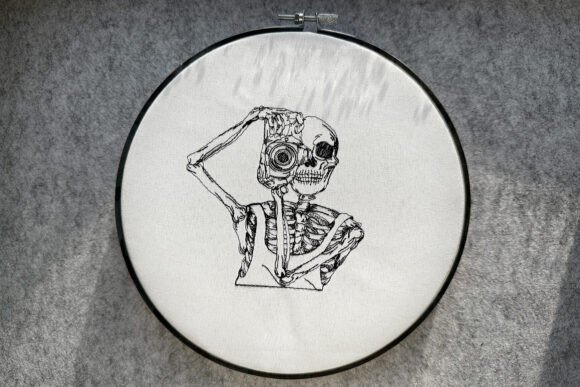
Skeleton with Camera Machine Embroidery
A Playful, Seasonal Spark for Halloween Collections
As an embroidery designer who’s built dozens of holiday collections for Etsy sellers and small-batch apparel studios, my first impression of the Skeleton with Camera Machine Embroidery design is immediate: it’s clever, cohesive, and instantly recognizable. It lands squarely in that sweet spot between spooky and sweet—quirky without being childish, artistic without feeling obscure. The one-line technique gives it a hand-drawn charm that reads as modern and intentional, not rushed or simplified. It feels festive but not overly commercial, nostalgic but not dated. For Halloween-themed products, this isn’t just decoration—it’s personality with purpose.
Where This Design Shines on Real Holiday Products
The Skeleton with Camera Machine Embroidery thrives where storytelling meets wearability. On heavyweight cotton sweatshirts, it becomes a conversation starter—ideal for family matching sets or “photographer’s Halloween” merch. As a tote bag design, it adds wit to farmers’ market hauls or craft fair displays. On kitchen towels and aprons, it brings lighthearted charm to seasonal home decor—think “haunted darkroom” or “ghost photographer” themes. As a pillow cover motif or embroidered patch, it scales beautifully for gift-ready bundles: pair it with film-roll ribbon, vintage camera pins, or printable mockups for social media previews.
For Etsy sellers, this design performs especially well in curated listings—imagine it stitched on organic cotton onesies (as a handmade gift for photographer parents), or as a limited-edition ornament backed with felt and hung with twine. Its clean silhouette ensures strong visual recognition at thumbnail size, boosting click-through rates. And because it leans into creativity rather than cliché, it helps small shops stand out amid sea of pumpkins and bats.
Smart Placement & Practical Limits
Like any strong seasonal embroidery asset, the Skeleton with Camera Machine Embroidery demands thoughtful application. Avoid placing it on curved caps or stretchy knit fabrics unless you’ve tested stabilizer combinations thoroughly—its continuous line relies on even tension. On thick terry cloth kitchen towels or heavy linen table linens, confirm stitch density won’t cause puckering; lighter fabric textures handle the flow better. Dark fabric? Test thread colors carefully—matte black or charcoal gray thread often reads richer than pure black, especially under holiday lighting. Metallic thread can add flair, but only if your machine handles fine metallics reliably; otherwise, stick to high-sheen polyester for shine without breakage.
Don’t force it into tiny hoop sizes—this design’s charm lives in its confident line work, not miniaturization. Skip ultra-small placements like baby socks or keychain patches unless you’ve verified legibility post-stitch. And while it’s perfect for personalized gifts, avoid pairing it with dense custom text inside the same hoop—keep personalization separate (e.g., name on a tag, not woven into the skeleton’s pose).
Why It Elevates Your Holiday Shop Strategy
Holiday shoppers don’t just buy products—they buy mood, memory, and meaning. The Skeleton with Camera Machine Embroidery taps directly into creative identity: the photographer, the documentarian, the observer who finds magic in the everyday—even in October. That emotional resonance lifts perceived product value. A sweatshirt with this design feels more intentional than generic Halloween gear. A set of embroidered pillow covers becomes a curated vignette, not just decor. That builds customer trust: buyers recognize craftsmanship and curation, not mass-produced filler.
For brand consistency, this design works across categories without needing rebranding—same motif, different contexts. Use it on packaging tags, printable promotional graphics, or Instagram story highlights to unify your holiday drop. And because it’s rooted in storytelling—not just seasonality—it stays relevant beyond Halloween week, supporting year-round appeal for photography studios, art schools, or creative retreats.
Embroidery Designer Notes You Can’t Skip
- Test thread colors on both light and dark fabric—especially for the camera lens and bone highlights. What reads crisp on ivory may vanish on navy.
- Check stitch density before bulk production. High-density fills can overwhelm the one-line elegance; aim for balanced coverage that preserves motion.
- Confirm hoop size compatibility with your most-used machines—and verify whether the design fits standard 4x4, 5x7, or larger hoops without scaling.
- Use proper stabilizer based on fabric texture: cutaway for knits, tear-away for stable wovens, and lightweight fusible for delicate linens.
- Create realistic mockups—not just flat digital renders. Stitch a sample on your target fabric, photograph it in natural light, and use that for Etsy listings and ads.
- Review small details after stitching: Does the camera strap read clearly? Is the skeleton’s pose expressive at final size? Adjust if needed before batch runs.
- Plan matching color palettes across your collection—e.g., charcoal, cream, rust, and slate—to reinforce cohesion in gift bundles and social feeds.
- Confirm commercial licensing before selling finished seasonal products. If you’re an Etsy seller or small shop owner, ensure your purchase includes rights for resale of physical embroidered items.
Final Thought: A Design That Sells Because It Connects
The Skeleton with Camera Machine Embroidery isn’t just another holiday embroidery file—it’s a narrative shortcut. In a crowded marketplace, it helps handmade gift makers say something distinct: “We celebrate the creators, the watchers, the ones who capture joy—even when it’s wrapped in bones.” Whether stitched on a cozy sweatshirt, a reusable tote, or a framed pillow cover, it invites customers in. That’s the quiet power of great seasonal embroidery: it doesn’t shout “Halloween”—it whispers, “This is *you*.” And that’s what turns browsers into buyers, and seasonal drops into repeat customers.